How Delivery Architecture Enables Predictable Software Projects
Learn how to design software projects for predictable delivery using Delivery Architecture. Align Code Design, System Design, and Project Design to control complexity, reduce risk, and deliver on time and on budget.

In software development, predictable delivery—hitting deadlines and staying within budget—is often seen as an exception rather than the rule. But it doesn’t have to be that way. The key lies in a deliberate Project Design approach that combines engineering discipline with architectural foresight.
This article outlines the principles and techniques I apply when building predictability into complex software projects. These are part of a broader Delivery Architecture mindset, where Code Design and System Design align with project execution to reduce uncertainty and increase control.
Why Predictable Delivery Is Hard
Software systems are inherently complex. Requirements shift, understanding deepens as work progresses, and visibility into progress can be limited. Many teams plan based on gut feeling or past experience, which breaks down quickly in larger or evolving projects.
Predictable outcomes don’t come from hope—they come from systems thinking and structured design. Just as you wouldn’t construct a building without blueprints, you shouldn’t start delivery without an architecture that supports it.
Key Practices for Predictable Software Delivery
Below are the core practices that I use to bring predictability into the delivery process, grounded in both Code Design and Project Design principles.
1. Map Work as a Dependency Network
Project activities should never be treated as a flat backlog. Each task interacts with others—some are prerequisites, others rely on shared resources or outputs. The first step in a reliable Delivery Architecture is to model your project as a graph of dependent activities.
By using an Activities Network (or Dependency Graph), you gain visibility into how tasks relate. This enables float analysis and critical path estimation—tools that are essential for accurate forecasting and risk management.
Dependencies may be:
- Technical: A feature needs a shared service or API.
- Resource-based: A specialist is needed in multiple places.
- Output-based: One component generates input for another.
This model becomes the foundation of your project planning and informs how teams are aligned and work is scheduled.
2. Stable Architecture Enables Predictable Change
A resilient System Design should not shift every time new features are introduced. Changing the architecture midway through a project is expensive and disruptive. A good Delivery Architecture assumes the system will evolve functionally without needing to be structurally redesigned.
To achieve this, avoid feature-based decomposition. Instead, design around volatility. Encapsulate areas that are expected to change frequently, so that those changes don’t ripple through the entire system.
This kind of separation makes change measurable and impact easier to assess—one of the cornerstones of predictable delivery.
3. Build in Stable Increments
Software delivery should progress incrementally. Once a module, service, or layer is complete, it should be locked unless there's a clear justification to revisit it. Otherwise, the project gets trapped in a loop of rework, and forward momentum stalls.
In Code Design, this means being intentional about which parts of the system are stable foundations, and which are extensions or configurable layers.
The analogy with construction applies: you pour the foundation, then build the structure floor by floor. You don’t pour the foundation, finish the kitchen, tear it down to redo the plumbing, and then go back to the basement.
You can still stagger work for speed, but components must be layered properly. For example, in real-world construction, while upper levels are being poured, the lower ones are already being finished.
Design, however, is cheap to iterate—before coding begins. That’s why System Design must be done interactively and iteratively, allowing multiple passes to validate assumptions before implementation begins.
4. Don’t Accumulate Bugs
Defects introduce chaos into schedules. A single unresolved bug can have cascading effects on other teams, timelines, and budgets.
The best way to control this uncertainty is to adopt a zero-tolerance policy for defects. Every bug is addressed immediately—not necessarily fixed right away, but fully understood and scoped. The unknown is the real problem, not the defect itself.
In a well-structured Delivery Architecture, bugs are treated as blockers to progress and eliminated as soon as they are found.
5. Use Estimate Ranges, Not Wishful Thinking
Estimates are necessary, but they should serve the plan—not the ego. The goal is to produce accurate, not overly precise, estimates.
Focus on activity duration buckets (5, 10, 15, 20 days). If something takes more than that, it should be broken down. This allows for averaging effects, where some overruns are offset by faster-than-expected completions.
The structure of your activity network will ultimately shape your delivery timeline more than individual estimates. That’s why detailed network modeling is a critical part of Project Design.
6. Track with Engineering Discipline
Planning is only half the equation. Without tracking, predictability fades fast.
Use your activities network as a live reference. Update it based on progress. Recalculate float and critical paths weekly. Redefine “done” as “reviewed and usable by the next activity.”
This tracking method enables timely corrective actions and gives real-time insight into how far off-plan you are and why.
A Delivery Architecture approach treats the project like a system—observe, measure, and adjust continuously.
Conclusion: Design + Execution = Predictability
Predictable delivery doesn’t come from luck or rigid processes. It comes from smart System Design, structured Code Design, and thoughtful Project Design—all aligned under a cohesive Delivery Architecture.
It also depends on tight collaboration between the architect and the project manager. The architect ensures the system is designed for change without disruption. The PM ensures the plan adapts to reality without losing control.
When design and execution stay in sync, delivery becomes something you can count on—not just hope for.
Code Design for Predictability: Why You Should Hide the Frameworks
Software projects rarely collapse because of lack of talent. They collapse because complexity grows faster than it is controlled. When technical failure happens, the root cause is often unmanaged complexity. You have seen it: - Small changes become expensive. - Adding developers does not increase speed. - Deadlines move again
Designing Resilient Software Systems for the Energy Sector
Resilience is the primary requirement for software systems in the energy sector. These systems support critical operations such as grid balancing, energy trading, risk management, and asset management. Failure is not an option. Energy systems must operate continuously. Orders must always be processed. Data loss is unacceptable. Business processes must
How Delivery Architecture Enables Predictable Software Projects
Learn how to design software projects for predictable delivery using Delivery Architecture. Align Code Design, System Design, and Project Design to control complexity, reduce risk, and deliver on time and on budget.
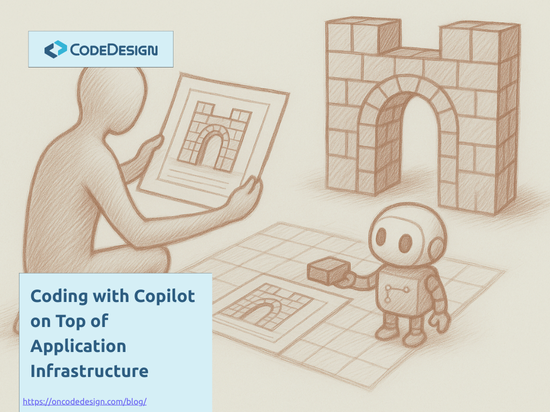
Coding with Copilot on Top of Application Infrastructure
AI coding works best on top of strong Application Infrastructure. With clear structure, strict boundaries, and consistent design rules, Copilot and AI Agents generate cleaner, more predictable code. Architecture guides the AI, not the other way around.
Integration Gateway for External Systems
An Integration Gateway isolates your system from external changes and failures while standardizing communication. This article explores a Code Design approach using Contract-First Design, Pluggable Applications, and Clean Architecture for reliable and maintainable software integration.
Viewing Software Projects Through an Activities Network
Learn how Activities Network Diagrams improve Project Design and Project Management by clarifying dependencies, reducing cost, and increasing predictability of delivery, budget, and quality in complex software projects.
Drawing from our extensive project experience, we develop training programs that enhance predictability and reduce the cost of change in software projects.
We focus on building the habits that make developers adopt the industry best practices resulting in a flexible code design.


